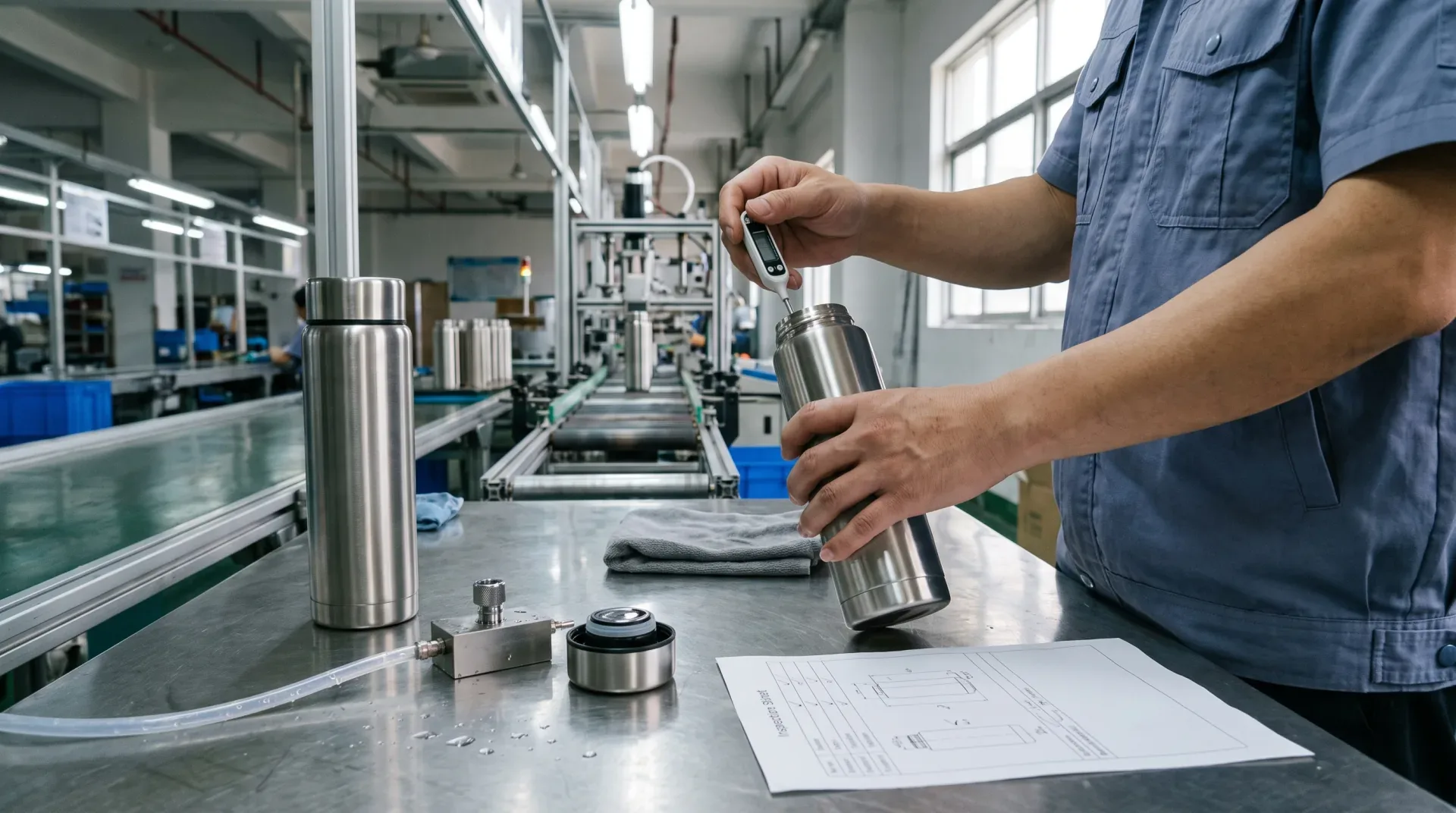
The reusable drinkware category — stainless steel water bottles, tumblers, vacuum flasks — represents one of the most heavily sourced product segments from China. Walk into any major retailer's drinkware aisle and you'll find shelves lined with products that, somewhere along the supply chain, passed through a Chinese factory. The manufacturing capability here is concentrated, the supply chain mature, and the unit economics favor volume production.
Yet beneath the surface of this seemingly straightforward product lies a minefield of invisible quality variables. A bottle can appear flawless — gleaming powder coat finish, smooth threading, a satisfying click when the lid shuts — while harboring defects that won't surface until days or weeks into customer use. Perhaps the insulation fails to hold temperature. Maybe there's a pinhole in the interior weld that causes a slow leak. Or the lid gasket degrades after a month of dishwasher cycles.
Visual inspection alone won't catch these manufacturing defects. This guide examines stainless steel drinkware sourcing from the buyer's perspective, covering material grades and their real implications, vacuum insulation mechanics and verification methods, China's production regions and their specialties, MOQ and tooling considerations, decoration techniques, supplier verification protocols, quality risks, and the testing regimens that distinguish a properly manufactured bottle from one destined to fail in the field.
Understanding Stainless Steel Grades
Material selection forms the foundation of drinkware quality. Choose incorrectly here, and no amount of surface finishing or quality control can compensate for fundamental material inadequacy.
304 (18/8) Stainless Steel
The industry standard for food-contact drinkware remains 304 stainless steel, often labeled as 18/8 to indicate its 18% chromium and 8% nickel composition. This alloy resists corrosion, imparts no metallic taste, and withstands repeated washing cycles. Most reputable brands specify 304 for both interior and exterior surfaces.
However, "304" appearing on a specification sheet doesn't constitute verification. Factories operating without stringent incoming material inspection may inadvertently (or deliberately) use lower-grade steel or mixed scrap. A simple magnet test provides initial screening — authentic 304 should exhibit non-magnetic properties or only weak magnetism after cold working processes. Strong magnetic attraction suggests a different grade entirely. For definitive verification, buyers should request material composition analysis via spectrometry from an accredited laboratory.
316 Stainless Steel
The addition of molybdenum distinguishes 316 from 304, enhancing resistance to chlorides and acids. This grade suits marine environments and products intended for extended contact with acidic beverages like citrus-infused water or sports drinks. The material commands a price premium over 304, and fewer factories maintain it as standard inventory. When specifying 316, the cost differential should appear clearly in quotations, and material certificates must explicitly identify the grade.
201 Stainless Steel
Manufacturers seeking cost reduction sometimes turn to 201 stainless, which substitutes manganese for some of the nickel content. This grade exhibits inferior corrosion resistance and fails to meet food-grade standards in many regulatory jurisdictions. Some budget-oriented drinkware employs 201 for the outer body while maintaining 304 for liquid-contact surfaces. While potentially acceptable when the outer wall does not contact beverages, this dual-grade construction should be explicitly specified rather than assumed.
Material Grade Comparison
| Grade | Composition | Corrosion Resistance | Food Contact | Relative Cost | Best Use |
|---|---|---|---|---|---|
| 304 (18/8) | 18% Cr, 8% Ni | Good | Yes (standard) | Baseline | Interior and exterior of most bottles |
| 316 | 16-18% Cr, 10-14% Ni, 2-3% Mo | Excellent | Yes (premium) | 20-30% higher | Acidic beverages, marine use |
| 201 | 16-18% Cr, 3.5-5.5% Ni, 5.5-7.5% Mn | Lower | Not universally accepted | 15-25% lower | Exterior only (non-contact) |
Vacuum Insulation: How It Works and How It Fails
The Double-Wall Vacuum
Vacuum-insulated bottles employ two walls separated by an evacuated space. This vacuum dramatically impedes heat transfer, maintaining beverage temperatures for extended periods. Without proper vacuum integrity — or when the vacuum degrades over time — the bottle performs no better than a single-wall container with trapped air providing minimal insulation.
Manufacturing creates the vacuum by evacuating air through a small port in the base, subsequently sealed permanently. The quality of this seal, combined with the integrity of welds joining inner and outer walls, determines whether vacuum performance persists throughout the product's lifetime.
Vacuum Testing Methods
Two practical approaches verify insulation performance:
Temperature retention testing involves filling the bottle with water at a specified temperature (typically 95°C / 203°F), sealing it, then measuring temperature decline over 6, 12, and 24 hours in controlled ambient conditions (20-25°C). A properly insulated 500ml bottle should maintain water temperature above 60°C after 6 hours and above 40°C after 12 hours. These figures serve as approximations — buyers should specify exact requirements in quality agreements.
External wall temperature checks offer quick screening. Fill the bottle with boiling water, seal it, wait 3-5 minutes, then touch the outer wall. Warmth on the exterior indicates compromised or absent vacuum. While this method lacks precision, it immediately identifies gross failures.
Production lots require AQL sampling plans incorporating temperature testing into pre-shipment inspection protocols. Testing a single bottle from a 10,000-unit order provides no statistically meaningful data about batch quality.
Common Vacuum Failure Modes
Weld porosity manifests as microscopic gaps in the junction between inner and outer walls, allowing air to gradually infiltrate the vacuum space. Insulation performance deteriorates progressively over weeks or months.
Getter degradation occurs when factories place getter material inside the vacuum space to absorb residual gases. Improper activation or insufficient getter quantity relative to vacuum volume accelerates performance decline.
Bottom cap leaks represent the most frequent field failure for vacuum bottles. The evacuation port seal at the bottle base fails from impact damage (dropping) or thermal cycling stress.
Base design influences failure rates significantly. Bottles featuring flat, seamless-appearing bases typically employ welded-on bottom caps concealing the evacuation point. Uneven or poorly executed welds create both cosmetic defects and structural vulnerabilities.
China's Stainless Steel Drinkware Production Regions
Yongkang (Zhejiang)
Often called "China's Hardware Capital," Yongkang dominates global stainless steel cup and bottle manufacturing. The city hosts hundreds of manufacturers specializing in vacuum flasks, water bottles, tumblers, and food containers. An integrated ecosystem of steel suppliers, mold makers, lid manufacturers, and coating facilities supports this concentration.
This density creates both advantages and complications. Having every input available within a 30-minute radius accelerates lead times. However, the concentration also fosters intense price competition that can compromise quality. Additionally, similar company names and factory facades can confuse buyers attempting to identify their actual business partners.
Jieyang (Guangdong)
Serving the broader kitchenware and tableware industry, Jieyang's stainless steel sector produces more utilitarian drinkware — canteens and classic thermos designs rather than the lifestyle-branded tumblers and custom-colored bottles that characterize Yongkang's output. While prices may be lower, decoration capabilities tend to be more limited.
Chaozhou (Guangdong)
Though primarily focused on kitchenware and food service products rather than consumer drinkware, Chaozhou's stainless steel cluster occasionally handles simpler bottle designs and bulk wholesale orders.
Production Region Comparison
| Region | Specialty | Cost Level | Decoration Capability | Best For |
|---|---|---|---|---|
| Yongkang (Zhejiang) | Full range: bottles, tumblers, flasks | Medium | High (powder coating, printing, laser) | Most consumer drinkware projects |
| Jieyang (Guangdong) | Classic thermos, canteens, simpler designs | Lower | Medium-Low | Budget and utilitarian products |
| Chaozhou (Guangdong) | Kitchenware crossover | Lower | Low | Simple bulk orders |
MOQ and Tooling Realities
Stock vs Custom Molds
Unlike plastic injection molding, stainless steel drinkware production employs different tooling concepts. Bottle bodies emerge from stainless steel sheets through sequential processes — cutting, deep drawing, necking, threading, welding — rather than injection into molds. What the industry terms "molds" actually refers to forming dies and tooling sets used in these operations.
Stock bottles utilize the factory's existing tooling inventory. Buyers select from catalog shapes and sizes, customizing through decoration, lid selection, and packaging. MOQs for stock bottles typically begin at 500 to 1,000 units, though per-color minimums apply. A factory might accept 1,000 total bottles while requiring at least 300 units per color variation.
Custom bottle shapes necessitate new forming tooling — stretching dies, necking tools, threading equipment — with costs ranging from $3,000 to $15,000 depending on complexity. Custom MOQs generally start between 3,000 and 5,000 units.
Lid Tooling
Lids, typically injection-molded from plastic materials (PP, Tritan, ABS), carry their own tooling cost structures. Simple flat lid molds might cost $1,000 to $3,000, while complex flip-top or straw lid designs incorporating multiple moving parts can reach $5,000 to $10,000. Silicone gaskets require separate compression molds costing $500 to $2,000.
MOQ and Tooling Summary
| Component | Stock MOQ | Custom Tooling Cost | Custom MOQ | Lead Time |
|---|---|---|---|---|
| Bottle body (steel) | 500–1,000 | $3,000–$15,000 | 3,000–5,000 | 35–50 days |
| Simple lid (PP) | Matches bottle | $1,000–$3,000 | 3,000–5,000 | Lid mold: 20–30 days |
| Complex lid (flip/straw) | Matches bottle | $5,000–$10,000 | 5,000+ | Lid mold: 25–35 days |
| Silicone gasket/seal | Low (thousands) | $500–$2,000 | 5,000+ | 15–20 days |
| Decoration tooling | N/A | $100–$500 per design | Minimal adder | Included in bottle lead time |
Coating and Decoration Options
Powder Coating
Powder coating dominates exterior finishes for stainless steel bottles. Dry powder applied electrostatically and cured under heat creates durable, uniform finishes. Key quality variables include:
- Coating thickness: Insufficient thickness leads to premature wear; excessive thickness causes chipping. Specifications typically target 60-120 microns.
- Adhesion: Inadequate surface preparation — insufficient cleaning or roughening of steel surfaces — results in coating delamination, particularly after thermal cycling or dishwasher exposure.
- Color consistency: Maintaining batch-to-batch color matching demands pigment control that lower-tier factories may lack.
Quality agreements should specify adhesion testing (cross-hatch test per ASTM D3359 or ISO 2409) and color measurement (Delta E specification against master standards).
Paint and Spray Finishes
Liquid paint enables effects beyond powder coating's capabilities — gradients, metallics, pearlescent finishes. The trade-off typically involves reduced durability. A painted bottle that chips after brief gym bag use reveals a finish mismatched to the product's intended application. Buyers should inquire about hardness testing (pencil hardness per ASTM D3363) and impact resistance specifications.
Sublimation Printing
This process transfers dye into polymer coatings on bottle surfaces, producing full-color, photographic-quality graphics. Popular for promotional and personalized drinkware, sublimation requires specific coating formulations (typically polyester-based powder coats). Standard powder coatings won't accept sublimation ink — buyers must confirm compatibility explicitly.
Laser Engraving
Laser technology removes coating to expose underlying stainless steel, creating permanent, wear-resistant markings. While suitable for logos, text, and simple graphics, the process limits output to single colors (natural steel appearance) and cannot produce gradients or photographic images.
Screen Printing and Pad Printing
Screen printing transfers ink through mesh screens onto bottle surfaces. Pad printing employs silicone pads to transfer ink from etched plates to curved surfaces. Both methods appear more frequently on bottle bases or lids than main bodies. Durability depends on ink formulation and curing processes — buyers should request adhesion testing and dishwasher resistance data.
Decoration Comparison
| Method | Durability | Color Range | MOQ Impact | Cost | Best For |
|---|---|---|---|---|---|
| Powder coating | High | Wide (pantone matchable) | Low (with stock colors) | Low-Medium | Main body finish |
| Liquid paint | Medium | Very wide (gradients, effects) | Moderate | Medium | Premium/luxury finishes |
| Sublimation | Medium | Full color, photo quality | Low | Medium | Custom graphics, promos |
| Laser engraving | Very high | Single color (steel) | Very low | Low | Logos, text |
| Screen printing | Medium | Wide | Low | Low-Medium | Logos, simple graphics |
Supplier Verification for Drinkware
Visual Inspection vs Performance Testing
Cosmetic inspections — examining for scratches, coating uniformity, thread smoothness — identify certain defects while completely missing functional failures that matter most: vacuum integrity, lid seal effectiveness, gasket durability, and material grade accuracy. Comprehensive inspection protocols must address both categories.
Factory Audit Points
Material incoming inspection procedures reveal whether factories verify steel grades of incoming sheet materials. Buyers should request to see spectrometer equipment or third-party material certificates for current production lots.
Welding quality control represents critical manufacturing steps, as welds joining inner and outer walls and attaching bottom caps create the highest failure risks. Understanding how factories test weld integrity and their defect rates at these stations provides insight into overall quality management.
Vacuum testing stations dedicated to checking every unit or employing statistical sampling indicate quality commitment. Factories lacking such stations rely solely on assembly quality, which proves insufficient for ensuring long-term performance.
Leak testing protocols should pressure-test or water-test bottles for lid seal and body integrity. Buyers should understand testing methods and acceptable quality levels (AQL).
Coating line conditions directly impact finish quality. Powder coating demands clean, controlled environments. Dust control, curing oven temperature consistency, and pre-treatment quality (cleaning/phosphating) determine coating durability.
Assembly line QC varies depending on whether lids are assembled in-house or sourced pre-assembled. Pre-assembled lids from third parties introduce additional quality variables beyond the bottle factory's control.
Key Verification Questions
- "Can you show me the vacuum testing station on a live video call?"
- "What steel grade certificate can you provide for the current production batch?"
- "How do you test lid seal integrity and what's your acceptable leak rate?"
- "Where do your lids come from — do you mold them or buy them?"
- "What's your powder coating adhesion test method and spec?"
Quality Risks Table
| Risk | Cause | Detection | Prevention |
|---|---|---|---|
| Vacuum failure | Weld porosity, getter degradation | Temperature retention test, external wall temp check | Weld integrity testing, vacuum station QC |
| Lid seal leakage | Gasket misalignment, mold flash on lid | Water leak test, pressure test | Gasket inspection, lid fit check |
| Coating delamination | Poor surface prep, insufficient cure | Cross-hatch adhesion test | Surface prep spec, cure time/temp control |
| Color mismatch | Pigment batch variation | Colorimeter (Delta E) vs master | Color tolerance specification |
| Thread binding/cross-threading | Poor tooling tolerances | Functional test on samples | Thread gauge inspection, cycle testing |
| Material grade substitution | Supplier uses 201 instead of 304 | Magnet test (screening), spectrometry (confirmation) | Incoming material certification, random spectrometry |
| Bottom cap weld failure | Uneven welding, thermal stress | Visual inspection, drop test | Weld parameter control, drop test specification |
| Gasket degradation | Poor silicone quality, wrong compound | Accelerated aging test, dishwasher cycle test | Specify food-grade silicone, test per batch |
| Sharp edges/burrs | Incomplete deburring after forming | Visual and tactile inspection | Deburring process spec |
| Interior contamination | Inadequate cleaning after manufacturing | Visual with borescope, wipe test | Wash/dry procedure before assembly |
RFQ Checklist
When preparing requests for quotation, include these specifications:
- Bottle capacity and dimensions: Volume in ml/oz, height, diameter
- Material grade: 304 or 316 for interior, grade for exterior
- Wall construction: Single-wall or double-wall vacuum insulated
- Mouth opening: Wide mouth, standard, or custom
- Lid type: Flat, loop, flip-top, straw, handled — and material (PP, Tritan, ABS)
- Decoration: Powder coat color (Pantone), print design, laser engraving, sublimation
- Insulation performance spec: Temperature retention target (e.g., above 60°C at 6 hours)
- Testing requirements: Leak test, temperature retention, coating adhesion, material grade verification
- Packaging: Individual box, bulk, retail-ready, barcode requirements
- Certifications needed: FDA, LFGB, REACH, RoHS, Prop 65 as applicable
- Target quantity and delivery: Total units, per-SKU/per-color breakdown, delivery schedule
When to Use a Sourcing Agent
Engaging a sourcing agent for stainless steel drinkware makes sense in several scenarios:
Custom bottle shapes requiring significant tooling investment benefit from on-ground management during mold trials. High quality requirements for vacuum performance and coating durability justify ongoing inline inspection presence. Multi-factory sourcing — bottle bodies from one supplier, lids from another, packaging from a third — creates coordination complexity that agents can manage effectively.
Technical specification discussions with factory engineers often require Chinese-language capability that buyers may lack internally. When order values justify the cost (typically 5-10% of order value), professional sourcing support can prevent expensive mistakes and ensure specifications are properly understood and implemented.
Next Steps in Sourcing
Getting from research to production takes supplier identification, verification, and negotiation. For buyers who want support:
- Supplier shortlist: We can identify and pre-screen manufacturers matching your product specifications and quality requirements.
- Factory background check: Verify a supplier's registration, certifications, export history, and production capability before committing to tooling or deposits.
- Inspection support: Coordinate pre-shipment inspection to confirm product quality — vacuum performance, material grades, coating durability — before your order ships.
FAQ
What's the MOQ for custom stainless steel water bottles from China?
Stock bottles with custom decoration start at 500 to 1,000 units, though per-color minimums apply (typically 300 units per color). Custom bottle shapes requiring new forming tooling start at 3,000 to 5,000 units. Custom lids with new injection molds have their own MOQ of 3,000 to 5,000 units.
How do I test if a vacuum-insulated bottle actually works?
Fill with water at 95°C / 203°F, seal, and measure the temperature after 6 hours in a 20-25°C room. A well-insulated 500ml bottle should stay above 60°C. For a quick screening, fill with boiling water and feel the outer wall after 3-5 minutes — if it's warm, the vacuum is compromised. For production QC, specify temperature testing on a statistical sample per AQL.
What's the difference between 304 and 316 stainless steel for water bottles?
304 (18/8) is the standard food-contact grade, suitable for water and most beverages. 316 adds molybdenum for better resistance to chlorides and acids, making it preferable for acidic drinks (citrus-infused water, electrolyte beverages). 316 costs 20-30% more and fewer factories stock it. For plain water, 304 is sufficient; for anything acidic, 316 provides an extra safety margin.
Which region in China is best for stainless steel bottle manufacturing?
Yongkang (Zhejiang) is the major hub — the highest concentration of drinkware factories, the deepest supply chain, and the widest range of decoration capabilities. If you're starting from scratch, Yongkang is the default. Jieyang (Guangdong) offers lower costs but a narrower range of decoration and typically simpler product designs.
How do I verify that a bottle is really 304 stainless steel?
A magnet provides a quick screening — 304 should be non-magnetic or only weakly magnetic after cold working. A strongly magnetic bottle suggests a different grade. For definitive verification, request a material composition analysis (optical emission spectrometry or XRF) from an ISO 17025 accredited lab. Buyers should verify supplier claims through independent testing rather than relying on internal certificates alone.
What lid and gasket issues should I watch for?
The most common failures: gasket misalignment causing slow leaks, gasket degradation after dishwasher exposure, lid threads binding due to poor tolerancing, flip-top hinges loosening after repeated use, and silicone gaskets that pick up odors. Specify dishwasher-cycle testing, gasket material grade (food-grade silicone), and hinge cycle life in your quality agreement.
How much does powder coating tooling and setup cost?
Powder coating itself doesn't require per-design tooling — the variable cost is in the powder color and the setup time. Custom color matching may involve a $100-300 setup fee per color. Sublimation printing requires a polyester-based powder coat formulation; confirm compatibility explicitly rather than assuming the standard powder coat will accept sublimation ink.
How do I protect my custom bottle design from being copied?
Tooling agreements should specify mold ownership and restrict the factory from using your molds for other customers. Mark your molds and dies with identifiers. Register design patents or design rights in your key markets. Understand that enforcement in China requires legal action through Chinese courts — prevention through agreements and relationship management is more practical than litigation after the fact. This is not legal advice — consult qualified IP counsel for strategy specific to your situation.
What's the typical lead time for a custom bottle order?
Stock bottles with decoration: 25-35 days from order confirmation. Custom bottles with new tooling: 45-60 days including mold development, sampling, approval, and production. Complex lids add 10-15 days if new molds are needed. Sea freight to the US or Europe adds 3-6 weeks. Factor this into your planning — a custom bottle program from concept to delivery often takes 3-4 months end to end.
What testing documentation should I require before shipment?
At minimum: material grade certificate (spectrometry report), vacuum insulation test results, lid leak test results, coating adhesion test report, and food-contact compliance documentation (FDA 21 CFR or EU 1935/2004/LFGB as applicable). If decoration includes printing, add ink safety documentation. All test reports should come from an ISO 17025 accredited lab, not the factory's in-house testing. Buyers should verify the authenticity of test reports and treat all claims as requiring independent verification.
This guide reflects general sourcing practice and is not legal, regulatory, or compliance advice. Insulation performance figures are illustrative — actual performance depends on bottle design, ambient conditions, and manufacturing quality. Cost, MOQ, and lead-time figures are planning estimates based on typical ranges and vary by factory, order complexity, and market conditions. Buyers should independently verify all supplier claims, certifications, and compliance documentation. Material grade claims should be confirmed through independent testing. All supplier representations should be treated as claims requiring verification. Requirements vary by product and market — buyers should consult appropriate professionals for their specific situation.