Sourcing Guide
Custom Silicone Products from China: A Buyer's Sourcing Guide
Sourcing custom silicone parts — industrial gaskets, food-grade kitchenware, baby bottle components, medical seals — usually points you toward China, where a large share of the world's silicone product manufacturing is concentrated. The volume is there. The harder part is separating a capable factory from a polished trading company, and doing it before money changes hands.
This guide is written for the buyer side of the table: procurement managers, product designers, engineers, and founders who need to understand the process behind their part, compare suppliers honestly, and avoid the predictable mistakes that cost money and time. Nothing here is written from a factory's marketing perspective.
We walk through the manufacturing processes, material grades and what certifications actually prove, the main production regions, how to tell a real factory from a middleman, the questions worth asking in an RFQ, and the quality risks that show up at volume. Treat the cost and MOQ figures as planning estimates — useful for budgeting, not fixed quotes. For verification workflows, see our Verify hub; for regional context, see Cities.
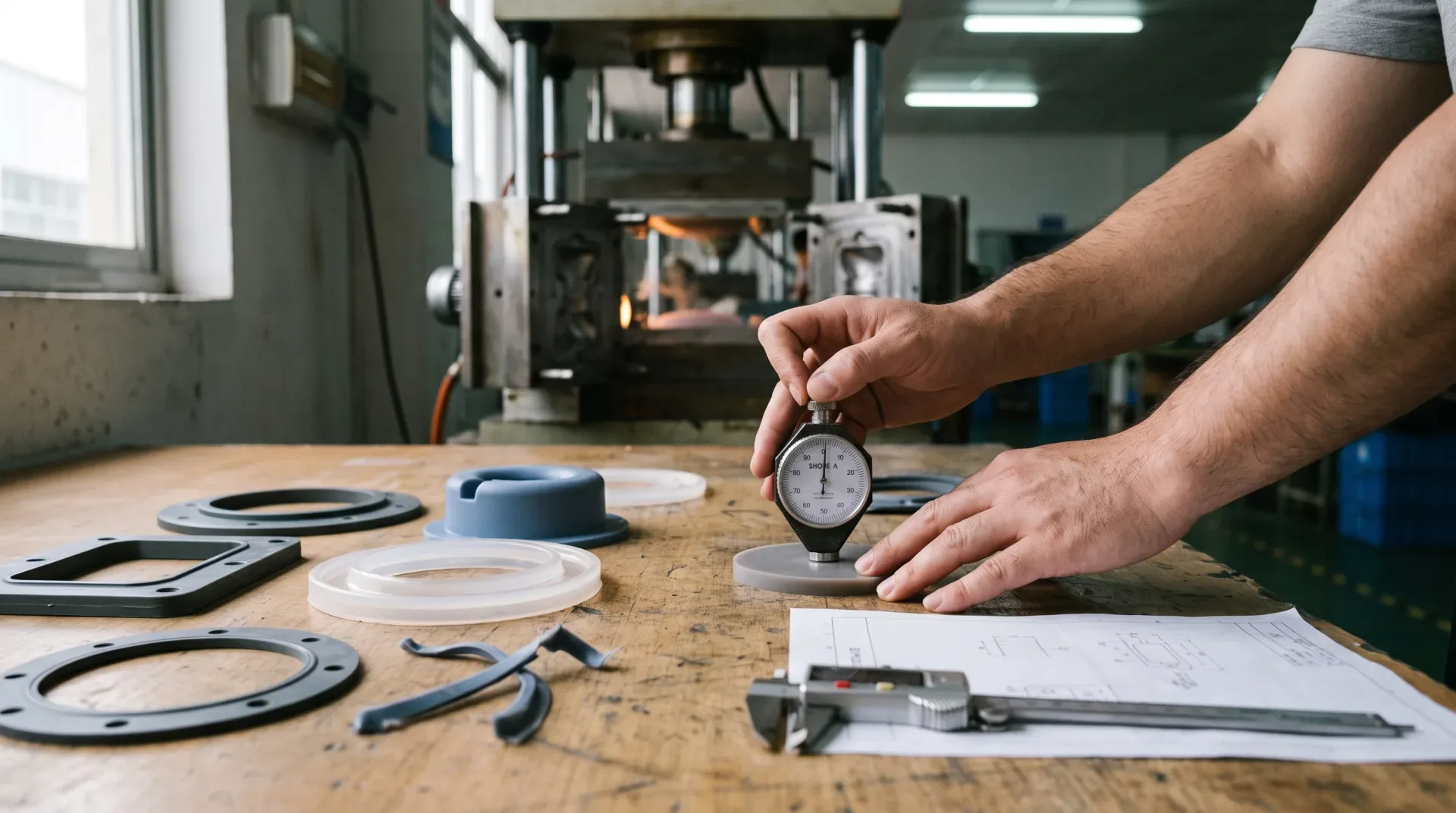
Understanding Silicone Manufacturing Processes
The process behind your part decides almost everything downstream: tooling cost, minimum order quantity, achievable tolerances, and which factories can realistically make it. Get this clear before you start comparing quotes, or you'll be comparing numbers that aren't measuring the same thing.
Compression Molding
The most common and accessible silicone process in China. A measured charge of solid silicone compound goes into a heated cavity, the mold closes under pressure, and the part cures.
It suits gaskets, seals, simple shapes, and larger parts where you don't need extremely tight tolerances. Tooling is the cheapest of any process — roughly $500 to $5,000 — and MOQs can sit as low as 100 to 500 units. The trade-off is flash: excess material at the parting line that has to be trimmed. When you request quotes, ask how the supplier handles flash removal and what flash limit they'll commit to in writing.
Liquid Silicone Rubber (LSR) Injection Molding
LSR injection pumps a two-part liquid system into a heated, closed mold under high pressure. It's the process for high-precision work — medical components, baby bottle nipples, micro-seals, and complex geometries.
Tooling runs higher, around $5,000 to $15,000, because LSR molds need tighter machining and cold-runner systems. MOQs typically start at 1,000 units. LSR capability is also a useful signal of real investment: a single machine with peripherals can cost $30,000 to $100,000. If a supplier claims LSR, ask to see the injection unit during a video walkthrough rather than taking the spec sheet at face value.
Extrusion
Extrusion produces continuous profiles — tubing, cords, weatherstripping, gaskets with a constant cross-section. Compound is forced through a die and cured in a heated oven or salt bath. Tooling generally falls between $1,000 and $5,000, with MOQs starting around 500 meters or units.
Worth asking extrusion suppliers: what cross-section tolerances they can hold, whether they cut to length in line, and whether they can co-extrude multiple colors or hardness levels in one profile.
Transfer Molding
Transfer molding handles parts with metal or plastic inserts — a silicone seal molded directly onto a connector housing, for example. The compound is forced from a transfer pot into the cavity around the insert. It needs more process control than basic compression molding, and the main risk is poor adhesion or flash around the insert. Tooling typically runs $2,000 to $8,000, with MOQs between 200 and 1,000 units.
Overmolding
Overmolding bonds silicone to another substrate — plastic, metal, or electronics — to create grips, protective boots, and sealed assemblies. The recurring failure mode is bond separation between the silicone and the substrate. Ask whether the factory uses self-bonding LSR grades or primers, and how they test bond strength per batch. Tooling tends to land between $3,000 and $12,000, with MOQs from 500 units up.
Process Comparison
| Process | Tooling Cost | Typical MOQ | Precision | Typical Applications |
|---|---|---|---|---|
| Compression Molding | $500–$5,000 | 100–500 | Medium | Gaskets, seals, simple shapes |
| LSR Injection Molding | $5,000–$15,000 | 1,000+ | High | Medical, baby products, complex geometries |
| Extrusion | $1,000–$5,000 | 500+ | Medium | Tubing, cords, continuous profiles |
| Transfer Molding | $2,000–$8,000 | 200–1,000 | Medium-High | Parts with inserts, connectors |
| Overmolding | $3,000–$12,000 | 500+ | High | Grips, boots, multi-material assemblies |
Silicone Material Grades and Certifications
Silicone isn't one material. The grade decides what the finished part is fit for and which documents a factory should be able to produce. The recurring trap is accepting a raw-material certificate as proof the molded part is compliant. It isn't. Requirements vary by product category and destination market — buyers should verify documents against their finished product and intended use.
Food-Grade Silicone (FDA, LFGB)
Food-grade silicone has to meet migration limits — substances shouldn't transfer from the silicone into food under intended use. The reference standards are FDA 21 CFR 177.2600 in the US and LFGB in Germany/EU. The common shortcut: a supplier shows a Dow or Wacker raw-material certificate and calls the finished product food-grade. That's not enough. Ask for a finished-product migration test report from an ISO 17025 accredited lab, covering the temperature and contact duration your product actually sees.
Medical-Grade Silicone (ISO 10993)
Medical-grade silicone needs biocompatibility testing per ISO 10993 and tighter contamination control, often in cleanroom conditions. Things to confirm: cleanroom classification, ISO 13485 for the factory, and batch-level biocompatibility reports. A factory running both industrial and medical silicone on shared equipment without proper segregation carries a real cross-contamination risk — worth probing directly.
Industrial-Grade Silicone
Industrial-grade covers seals, gaskets, vibration dampers, and protective parts with no food or body contact. Here the specs are mechanical: Shore A hardness, tensile strength, tear strength, compression set, temperature range. Name the relevant ASTM or ISO test method in your quality agreement so "passes" has a defined meaning.
Platinum-Cured vs Peroxide-Cured
Platinum-cured silicone uses a platinum catalyst and produces cleaner, lower-odor parts with fewer extractables — the usual choice for food-contact, medical, and baby products. Peroxide-cured silicone uses organic peroxide and is more common in industrial work. Peroxide curing can leave residual byproducts that cause odor or outgassing, which matters for sealed or consumer-facing parts. Ask which system the factory uses, and for food or medical work, ask for evidence of post-curing to drive off volatiles.
How to Verify Certification Claims
Logos on a website prove nothing on their own. Check the certificate number against the issuing body's database, confirm it covers the factory's actual production scope, and check the expiry date. An expired certificate — even from a legitimate body like SGS, TÜV, or BSI — isn't a current credential. And note that FDA registration is a facility registration, not a product approval; treat supplier claims as claims until you have documents that match your product and market.
The China Silicone Manufacturing Landscape
Key Production Regions
These regional notes reflect general sourcing patterns, not fixed rules. Any single factory can run against type, so use this to frame questions, not to draw conclusions. See our Cities section for broader regional guides as they are published.
- Dongguan (Guangdong) — One of the major silicone clusters in China, with hundreds of registered factories. Strong in custom molding, overmolding, kitchenware, baby products, and promotional goods. That factory count includes small workshops, so buyers should verify ISO 9001 and on-site molding capability; quality tiers vary widely here.
- Shenzhen (Guangdong) — High-end prototyping and precision parts, particularly electronics-adjacent silicone such as seals, gaskets, and overmolded connectors. Costs typically run above Dongguan. Some "suppliers" are design offices rather than factories — confirm there's a production floor.
- Huizhou (Guangdong) — Mid-tier overflow from Shenzhen and Dongguan, and a growing base for consumer silicone. QC culture tends to be less established than Dongguan, so audit the floor and batch records carefully.
- Zhongshan (Guangdong) — Specialized in silicone kitchenware, bakeware, and household items, with a strong food-grade base. Verify food-grade claims with finished-product test reports, not raw-material certs.
- Xiamen (Fujian) — A secondary cluster for kitchenware, baby products, and promotional items, with lower labor costs than Guangdong. The factory-versus-trader line is harder to read here; insist on a live video walkthrough of the floor and mold storage.
- Ningbo (Zhejiang) — Silicone seals, gaskets, and industrial parts, supported by a strong nearby plastics ecosystem. Silicone is often a secondary line, so confirm there are dedicated production lines rather than occasional runs.
Factory vs Trading Company: How to Tell
This is the question first-time buyers ask most. It matters because a trading company adds a margin — often 5 to 15 percent — and puts a layer between you and the people actually making the part. Neither is automatically bad, but you should know which you're dealing with.
Signals that point to a real factory:
- Machines visible and running — compression presses and/or LSR injection units on the floor, shown in a live walkthrough, not photos.
- LSR injection capability — real capital investment ($30K–$100K+ per machine); ask to see the unit and a mold change.
- In-house mold room or a documented, stable mold partner — if outsourced, ask to meet that partner.
- Material mixing and color-matching — a two-roll mill for pigment dispersion, plus color-match records.
- Post-curing capability — an oven and temperature/time logs, which matter for food and medical work.
- Documented QC workflow — incoming, in-process, and final inspection with AQL sampling and recent reports.
- Retained samples and batch-traceable material storage — both signal a factory that takes recall and consistency seriously.
Signals that point to a trading company:
- A broad, unrelated product range — silicone, plastic injection, metal stamping, and textiles under one roof usually means aggregation.
- Vague or stock factory photos — real factories can show their own floor, machines, and QC stations.
- Can't explain the process — a factory engineer can talk cycle time, mold temperature, injection pressure, and flash control.
- Evasive on tooling ownership — middlemen often dodge mold storage and transfer questions.
- Very low MOQ across many categories — 100 units across 50 product types reads like order aggregation.
- Won't do a live walkthrough — the single most telling refusal.
- Address doesn't match the production claim — an office in a Shenzhen tower with a "factory" elsewhere needs verification.
One signal proves nothing. But when three or more trading-company signals stack up with no matching factory signals, slow down. The most reliable single check remains a live video walkthrough showing machines running, mold storage, and the QC area — something a genuine factory can usually arrange within 24 to 48 hours. For a structured checklist, see Verify.
Supplier Verification Checklist
| Check | How to Verify | Red Flag If |
|---|---|---|
| Business License | National Enterprise Credit Info system | License scope doesn't include production |
| Factory Location | Live video walkthrough | Refuses or repeatedly delays the walkthrough |
| Molding Machines | Count and inspect during walkthrough | Stock photos or no machines visible |
| Certifications | Verify against issuing body database | Certificate expired or issuing body unknown |
| Export History | Request references from buyers in your region | No verifiable references at all |
| Mold Ownership | Ask about mold storage and transfer terms | Vague or evasive answers |
| Material Storage | Ask about batch traceability and FIFO | No lot tracking or rotation |
| QC Documentation | Request a recent inspection report | Cannot produce any sample reports |
MOQ, Tooling, and Cost Logic
Tooling Costs
Chinese mold costs tend to run 40 to 60 percent below Western equivalents, but the spread is wide and driven by cavity count, steel grade, part complexity (undercuts and side actions push cost up), and expected mold life. A single-cavity P20 compression mold for a simple gasket might land around $800; a four-cavity S136 LSR mold for a medical part can reach $15,000. Always pin down steel grade and expected cavity life in the quote — a cheap mold that wears out early is rarely a saving.
MOQ and Per-Unit Logic
| Factor | Low MOQ (100–500) | Medium MOQ (500–5,000) | High MOQ (5,000+) |
|---|---|---|---|
| Unit Price | Higher | Moderate | Lowest |
| Mold Type | Aluminum sample mold | Steel single-cavity | Steel multi-cavity |
| Supplier Type | Small workshop / trader | Mid-size factory | Large factory |
| Quality Consistency | Higher variance | Generally consistent | Most consistent |
MOQ is driven by material minimums, color changeover cost, mold cavitation, and packaging setup. When a supplier quotes an unusually low MOQ across many product types, ask how that MOQ is achieved — the answer usually tells you whether you're talking to a factory or a trader.
Hidden Costs
Plan landed cost, not ex-factory unit price. Beyond tooling and per-unit, budget for mold modification if samples need adjustment, freight and forwarding, customs duties, third-party inspection, and packaging tooling where custom packaging is involved.
Quality Control and Common Risks
Common Quality Issues
| Risk | What to Look For | How to Check |
|---|---|---|
| Flash | Excess material at the parting line | Specify a flash limit (e.g., ≤0.1mm) in the QC plan |
| Color Inconsistency | Variation between batches | Approve physical color chips; retain them for incoming inspection |
| Dimensional Drift | Parts outside specified tolerance | Specify tolerance range and inspection sampling method |
| Odor / Outgassing | Chemical smell in the finished part | Specify post-cure requirements; request post-cure logs |
| Low Tear Strength | Parts tear under normal use | Specify ASTM D624 tear testing per batch |
| Hardness Deviation | Softer or harder than specified | Specify a Shore A range (e.g., 60±5); ASTM D2240 testing |
| Certification Gaps | Only a raw-material cert offered | Request a finished-product report from an accredited lab |
Material Substitution and Post-Cure Shortcuts
Two risks deserve a direct mention. First, substitution: a factory may quietly use industrial-grade silicone where you specified food or medical grade. Request material certificates per batch and spot-test finished parts, especially on food-contact and baby products. Second, skipped post-curing: cutting the post-cure shortens cycle time but can leave volatiles that cause odor and outgassing. Write the post-cure requirement into the quality agreement and ask for the logs.
Sample vs Mass Production
Samples are often built on different tooling, with more operator attention, than a production run. Approving a sample tells you what a factory can make, not what it will make at volume. To close that gap, approve only pre-production samples from the actual production tooling, specify acceptable variance from the approved sample, and write AQL-based incoming inspection into the purchase order.
RFQ Checklist: What to Ask Before You Order
How clearly and quickly a supplier answers these is itself a signal.
- What experience do you have with parts similar to ours? Share relevant examples.
- Which molding processes do you run in-house (compression, LSR injection, extrusion, transfer, overmolding)?
- Do you design and fabricate molds in-house, or use an external mold partner?
- Which mold steel grades do you offer, and what is the expected cavity life for each?
- What is the estimated tooling cost and lead time for mold fabrication?
- What is your MOQ for our part's size, material, and color — and what drives it?
- Can you provide unit pricing at multiple volume tiers (100, 500, 1,000, 5,000, 10,000 units)?
- Which silicone grades do you work with, and can you source specific formulations (FDA, medical, high-temp)?
- Which certifications does your factory hold (ISO 9001, ISO 13485, BSCI, FDA registration)?
- Can you provide finished-product test reports, not just raw-material certs, for the relevant standards?
- What is your QC process — incoming, in-process, final — and what AQL level do you use?
- Do you offer post-curing, and can you provide post-cure temperature and duration logs?
- What are your payment terms for first-time buyers? Do you accept trade assurance or a letter of credit?
- Can we schedule a live video walkthrough of the production floor, mold room, and QC area?
- Who owns the mold, and what is the process for transfer if we change suppliers?
- What is your typical production lead time after mold approval, and how do you handle delays?
Factory Audit Checklist
If you're funding tooling or placing an order above roughly $5,000, an audit — by you, an agent, or a third-party inspector — is worth the cost.
- Verify the business license — match factory address to the registered address and confirm silicone/rubber production scope.
- Tour the production floor — count and inspect molding machines; are they running, and how many operators per machine?
- Inspect the mold room — in-house or outsourced; check storage, maintenance records, and mold tracking.
- Review material storage — temperature and humidity control, batch labeling, FIFO rotation.
- Check the mixing room — two-roll mill for color dispersion, cleanliness, and food-grade vs industrial segregation.
- Confirm post-cure capability — oven on site, temperature control, and cycle logging.
- Inspect the QC lab — durometer, tensile tester, color spectrometer, and calibration records.
- Review sample retention — does the factory keep retained samples from past batches?
- Check certification documents — verify ISO/FDA/BSCI against issuing-body databases and check expiry dates.
- Interview QC staff — headcount, AQL standard used, and a recent inspection report.
- Assess working conditions — PPE, cleanliness, and workflow organization, which track with quality culture.
- Review export experience — which countries, and references from buyers in your product category.
Payment, Tooling Ownership, and IP Risk
Mold Ownership
Settle mold ownership in the purchase contract before paying the tooling fee. The common arrangement is that the buyer owns the mold while the supplier stores and maintains it during the relationship; if things end, the buyer can request transfer. Some suppliers charge storage if no orders run for a long stretch. Have this conversation early — vague answers about ownership often foreshadow trouble moving production later.
Payment Terms
For first orders, 30% deposit and 70% before shipment after inspection approval is standard. For larger or higher-risk categories, consider trade assurance, a letter of credit, or staged payments tied to milestones. Avoid paying 100% upfront to an unverified supplier, and release the balance only after pre-shipment inspection passes.
Intellectual Property
Silicone molds can be reverse-engineered from CAD files, so consider filing a Chinese design patent before sharing detailed designs — it creates a basis for action, though no filing removes the risk entirely. An NNN agreement (non-use, non-disclosure, non-circumvention) is standard practice for the production relationship, with the caveat that enforceability varies. This is risk-control guidance, not legal advice; work with an IP attorney familiar with Chinese patent law for anything you intend to enforce.
When to Use a Sourcing Agent
An agent isn't needed for every order, but some situations earn the cost:
- First order with a new supplier — verification before payment catches quality, timeline, and certification gaps early.
- Custom tooling involved — paying $2K–$15K for a mold, an agent can track mold progress and confirm the production mold matches the approved sample.
- Food-contact or baby products — higher regulatory scrutiny; an agent can check material batch records, post-cure logs, and finished-product reports.
- Claims that are hard to verify remotely — a local agent can run an on-site audit with photographic evidence.
- Comparing several factories — a structured visit to three to five sites gives you a like-for-like comparison.
- Pre-shipment inspection — third-party inspection (SGS, Bureau Veritas, TÜV) is standard; an agent can coordinate, translate findings, and push corrections.
FAQ
How much does a custom silicone mold cost in China?
Plan on anywhere from around $500 for a simple single-cavity compression mold to $15,000+ for a multi-cavity LSR injection mold. Cavity count, steel grade, part complexity, and expected mold life drive the figure. Chinese mold costs typically run 40–60% below Western equivalents — confirm steel grade and cavity life in the quote rather than chasing the lowest number.
What MOQ should I expect for custom silicone products?
It depends on process, mold cavitation, color, and packaging. Compression molding often starts around 100–500 units; LSR injection usually starts at 1,000+. A supplier quoting 50-unit MOQs across many product types may be aggregating orders rather than making the part — ask how the MOQ is achieved.
Can a supplier provide FDA or LFGB test reports for the finished product, not just raw material?
A raw-material certificate from the compound maker only proves the base material meets the standard. Ask additionally for a finished-product migration test report from an ISO 17025 accredited lab, since the molded part — with its specific colorants and processing aids — needs to meet the standard under your intended use conditions. Many suppliers can arrange this; some will resist, which is itself worth noting.
What certifications matter for baby products, kitchenware, or medical silicone parts?
For baby products: FDA 21 CFR 177.2600, LFGB, EN 14350, and CPSC requirements. For kitchenware: FDA and LFGB for food contact. For medical: ISO 10993 biocompatibility and ISO 13485 for the factory's quality system. Verify each document against the issuing body's database and review it against your finished product and target market — don't rely on a logo alone.
How do I tell a real factory from a trading company?
The most reliable single check is a live video walkthrough showing molding machines running, the mold room, material storage, and the QC area. A genuine factory can usually arrange this within 24–48 hours. Supporting signals: a focused product range, the ability to discuss process details, and a business license that lists actual manufacturing as the registered scope. Trading companies often hesitate or stall when you ask to speak directly with QC or production staff.
What lead times are realistic for custom silicone orders?
Budget 25–35 days for production after sample approval, plus 7–15 days for the mold if one is needed. Add shipping on top — roughly 30–40 days by sea to the US or EU, or 5–10 days by air for smaller, urgent shipments. First orders almost always run longer than reorders, so don't plan a tight launch around an initial production run.
Who owns the mold after I pay for it?
If you pay the full tooling cost, the mold should be yours — but only if your contract says so explicitly. Many suppliers treat the mold as their property by default and will resist releasing it if you try to move production elsewhere. Put ownership, storage terms, and transfer conditions in writing before you pay the tooling deposit.
How do I protect my design or proprietary product?
A bilingual NNN agreement (non-disclosure, non-use, non-circumvention) enforceable under Chinese law carries far more weight than a standard Western NDA. For products with real IP value, register your trademark and any applicable design patents in China before sending detailed files. Share full technical drawings only with shortlisted suppliers, and avoid handing your complete design to a dozen factories during the quoting stage.
What payment terms are standard, and how do I reduce risk?
The common structure is 30% deposit and 70% before shipment, paid by T/T. For larger or first-time orders, consider tying balance payment to passing a pre-shipment inspection. Avoid paying 100% upfront, and always send funds to a corporate account matching the supplier's registered name — a request to pay a personal or third-party account is a serious red flag.
Should I pay for a pre-shipment inspection?
For most custom silicone orders, yes. A third-party inspection (typically $200–$300) checks dimensions, color, surface defects, and quantity against your approved sample before the balance is paid. It's cheap insurance against receiving a container of off-spec parts you can't return, especially on a first order or any run with tight cosmetic tolerances.
How do I handle color matching for custom silicone?
Provide a Pantone reference rather than a verbal description, and approve a physical signed sample before mass production. Be aware that silicone color can shift slightly after curing and across material batches, so agree on an acceptable tolerance range upfront. Translucent and fluorescent shades are harder to hit consistently — flag these early.
Ready to Source?
Sourcing custom silicone well comes down to verifying the right things in the right order — and that's hard to do from another continent. AllForSourcing provides buyer-side support: supplier shortlisting, factory background checks, and audit or inspection coordination, all working for you rather than the factory. If you need help at any stage — from vetting a quote to managing a first production run — reach out and we'll point you in the right direction.
Request supplier supportarrow_forward