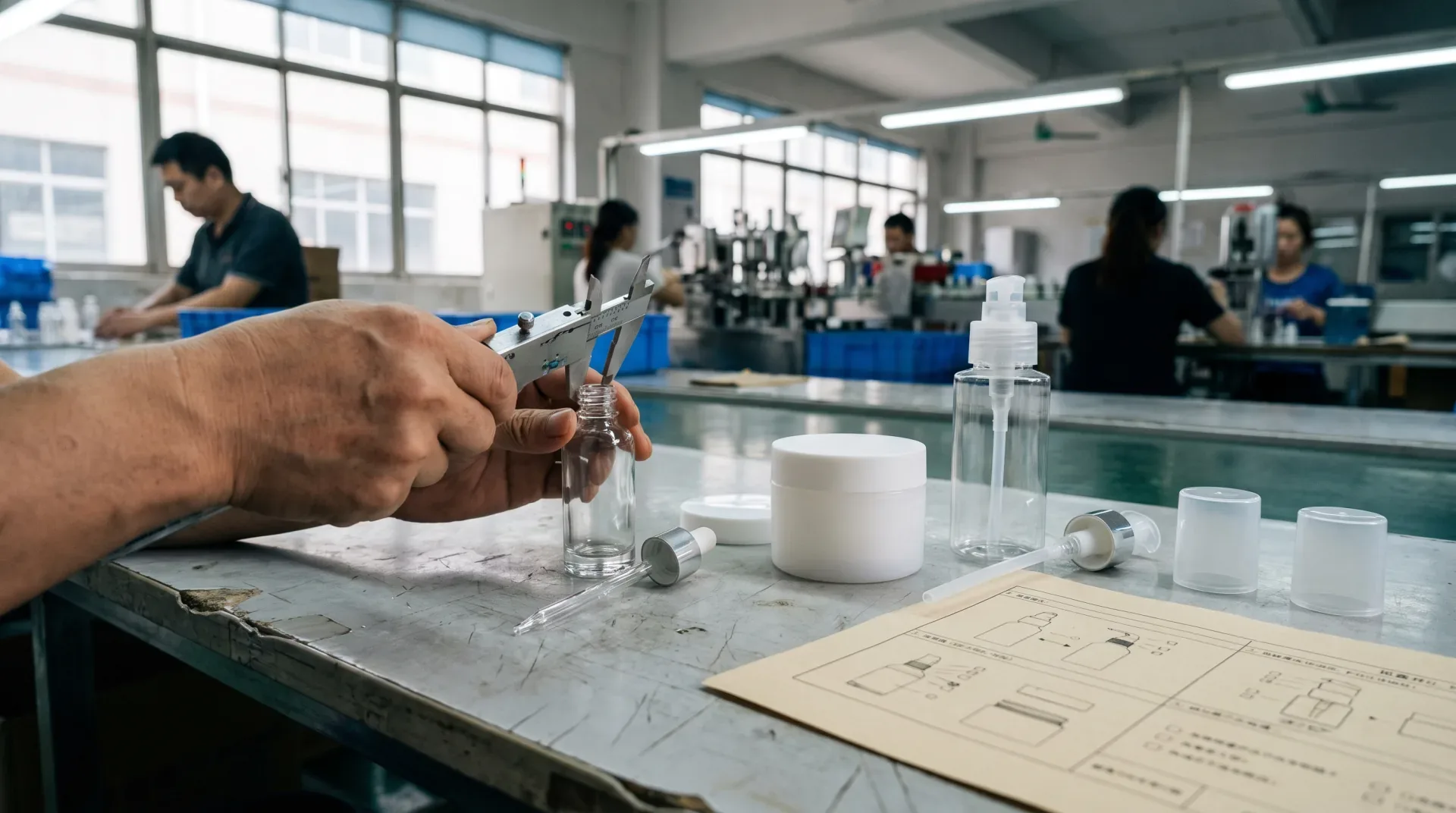
Sourcing cosmetic packaging — bottles, jars, tubes, compacts, pumps — often leads buyers to China, where a significant share of the world's beauty packaging supply chain is located. The factories are there. The decoration capability is there. What's less visible from the outside is which supplier actually controls the tooling, which one is reselling stock components at a markup, and whether the factory that cut your first samples is the same one that will run volume production.
This guide is written for the buyer side: cosmetic brand owners, private-label skincare founders, beauty product buyers, and packaging procurement managers who need to compare suppliers honestly, understand what MOQs and tooling costs actually mean, and avoid the mistakes that sink timelines and budgets. Nothing here is written from a factory's marketing perspective.
We cover the packaging types and materials, the main production regions, decoration techniques and what they cost, MOQ and tooling realities, supplier verification signals, quality risks that show up at volume, and the questions worth asking before you commit to a purchase order. Treat all cost and MOQ figures as planning estimates — useful for budgeting, but not fixed quotes.
Cosmetic Packaging Types and Material Options
Bottles and Jars
The major categories in cosmetic packaging are bottles and jars, available in glass, acrylic, PET, PP, and AS (acrylonitrile styrene).
Glass bottles and jars convey a premium feel and work well for serums, perfumes, and high-end creams. But glass is heavier (higher freight costs), breakable, and the molds cost more — typically $1,500 to $4,000 for a custom mold. Stock glass from a manufacturer's existing catalog avoids mold fees entirely and MOQs can sit as low as 500 to 3,000 units.
Acrylic (PMMA) looks close to glass but is lighter and less fragile. The trade-off is scratch sensitivity and some chemical compatibility limits — it's not suitable for every formula. Custom acrylic molds run around $2,000 to $6,000.
PET and PP are the workhorses. PET is clear and widely recyclable; PP is opaque or translucent with better chemical resistance. Tooling costs are lower — $1,000 to $3,500 for blow-molded PET, $2,000 to $5,000 for injection-molded PP — and both accept a wide range of decoration.
AS (acrylonitrile styrene) offers good clarity at a lower cost than acrylic and better scratch resistance than standard PS. It's common in mid-tier skincare jars and bottles where the brand wants a glass-like look without the weight or breakage risk.
Airless Pump Bottles
Airless pumps protect oxygen-sensitive formulas — vitamin C serums, retinol creams, natural preservative-free products — by dispensing without letting air back into the container. They're more expensive per unit than standard pumps and harder to prototype. If a supplier offers an airless system, ask whether they manufacture the pump mechanism in-house or assemble from purchased components. Pumps sourced from third-party manufacturers that the packaging supplier doesn't control introduce an additional quality variable.
MOQs for custom airless bottles usually start at 5,000 to 10,000 units. Stock airless bottles can run at 1,000 to 3,000 units with decoration applied. Expect to pay $0.50 to $3.00 per unit at volume, depending on bottle size, material, and pump quality.
Tubes
Cosmetic tubes come in plastic (PE, PP), laminate (multi-layer barrier), and aluminum. Plastic tubes suit hand creams, cleansers, and masks. Laminate tubes with EVOH or aluminum barrier layers protect sensitive formulas that need oxygen or light barriers. Aluminum tubes are typically for ointments and travel-sized products.
Crimping and sealing quality are the common failure points — a tube with a weak crimp leaks at the bottom seal. Ask tube suppliers for their seal integrity test method before committing. Tube MOQs typically start at 5,000 to 10,000 units for custom printing; stock tubes with label application can go as low as 1,000.
Compacts and Lipstick Tubes
Compacts and lipstick mechanisms are injection-molded parts that typically require multiple molds: a base, a lid, an inner tray for compacts; a base, a mechanism core, and an outer shell for lipsticks. Total tooling cost for a compact can run $4,000 to $12,000 across the mold set. MOQs usually start at 5,000 to 10,000 units.
The mechanical precision matters — a lipstick mechanism that wobbles or a compact hinge that loosens after 20 open/close cycles kills the perceived quality of the whole product. Ask for a cycle test report for moving parts.
Packaging Material Comparison
| Material | Clarity | Weight | Tooling Cost | Best For | Notes |
|---|---|---|---|---|---|
| Glass (soda-lime) | High | Heavy | $1,500–$4,000 | Premium serums, perfumes | Breakable, higher freight |
| Acrylic (PMMA) | High | Medium | $2,000–$6,000 | Look-alike glass jars | Scratch-prone, formula compatibility check needed |
| PET | High | Light | $1,000–$3,500 | Standard bottles, jars | Widely recyclable |
| PP | Opaque/translucent | Light | $2,000–$5,000 | Caps, closures, jars | Good chemical resistance |
| AS | High | Light | $1,500–$3,500 | Mid-tier jars, bottles | Good clarity-to-cost ratio |
| Aluminum | Opaque | Light | $1,500–$4,000 | Tubes, compacts | Barrier properties, dent-prone |
| PE (LDPE/HDPE) | Translucent/opaque | Light | $1,000–$2,500 | Tubes, soft bottles | Squeezable, limited decoration |
Decoration Techniques
Decoration is where a generic bottle becomes a brand's bottle. Chinese factories offer a wide range of decoration processes — far more than most Western packaging suppliers — but not every factory does every technique in-house. When a decoration step is outsourced, quality control gets harder and lead times get longer.
Silk-Screening
The most common and accessible decoration method. A mesh screen transfers ink onto the container surface. One to three colors is standard; beyond that, registration complexity and cost rise quickly. Suitable for simple logos, text, and line art on flat or gently curved surfaces. MOQ adder is usually minimal — often just a $50 to $150 screen setup fee.
Hot-Stamping
Transfers metallic foil (gold, silver, copper, holographic) onto the container surface using heat and pressure. Works on glass, plastic, and coated surfaces. The most common quality issue is incomplete transfer or foil peeling after customer handling. Ask for a tape adhesion test report before approving production.
Metallization / Vacuum Metallization
For full metallic finishes rather than foil accents. The container goes into a vacuum chamber where vaporized aluminum coats the surface. This requires specialized equipment that many smaller packaging factories outsource. When it's outsourced, confirm who handles rejects and who owns the scrap.
Spray Coating and UV Coating
Spray coating applies color or effect (matte, soft-touch, gradient) to the container exterior. UV coating adds a high-gloss or matte protective layer. Both require controlled environments — dust in the spray booth becomes specks in the finish. Ask about the factory's spray booth conditions and whether they have a dust-controlled coating line.
Electroplating
Applies a metallic layer (chrome, gold, nickel) to plastic containers through an electrochemical process. The environmental and worker-safety implications of electroplating in smaller Chinese workshops are real — and regulation varies by region. Larger factories with ISO 14001 environmental certification are more likely to have proper wastewater treatment, but verify rather than assume.
Labeling and Sleeving
Heat-shrink sleeves wrap around the container and conform to curves — a fast way to decorate complex shapes without direct printing. Pressure-sensitive labels are straightforward. Both are lower-cost decoration options, especially when MOQs are small. The main risk is shrinkage variance causing sleeve misalignment in production.
Decoration Decision Table
| Decoration | Setup Cost | Per-Unit Cost | MOQ Impact | Durability | Best For |
|---|---|---|---|---|---|
| Silk-screening | $50–$150/screen | Low | Minimal | Good | Simple logos, text |
| Hot-stamping | $100–$300/die | Low-Medium | Minimal | Good (tape test needed) | Metallic accents, luxury cues |
| Metallization | High (outsourced) | Medium | 5,000+ | Good | Full metallic finishes |
| Spray coating | $200–$500 setup | Medium | 3,000+ | Medium | Matte, soft-touch, color effects |
| Electroplating | Moderate | Medium | 5,000+ | Very good | Chrome/gold metallic plastics |
| Heat-shrink sleeve | $100–$300/design | Low-Medium | 2,000+ | Medium | Complex curved shapes |
| Pressure-sensitive label | $50–$150/design | Low-Medium | Very low | Medium | Small runs, fast turnaround |
China Cosmetic Packaging Production Regions
Yuyao (Zhejiang)
Yuyao, about two hours south of Shanghai, is one of China's major cosmetic packaging clusters. Hundreds of factories manufacture bottles, jars, pumps, caps, and compacts. The supply chain runs deep: mold shops, decoration houses, pump manufacturers, and assembly lines are all within a short radius.
The density is an advantage for access and lead times. It's also a risk: smaller workshops with inconsistent quality control operate alongside well-run factories, and company names, websites, and product photos can be similar enough to create confusion. A supplier with a polished Alibaba page in Yuyao might be a 15-person workshop or a 200-person factory with ISO 9001 — the online presence rarely differentiates them.
Shantou (Guangdong)
Shantou specializes in lower-to-mid-tier plastic cosmetic packaging, particularly for mass-market and promotional products. The cost structure is commonly lower than Yuyao, but the quality floor is also lower — buyers should verify capability case by case. Shantou is strong in injection-molded compacts, lipstick cases, and small jars.
Guangzhou (Guangdong)
Guangzhou's packaging supply chain is broad, serving beauty, personal care, and household products. The city benefits from proximity to Shenzhen's prototyping ecosystem and the export infrastructure of the Pearl River Delta. Guangzhou factories tend to be more comfortable with international compliance documentation than smaller regional players.
Shenzhen (Guangdong)
Shenzhen's packaging sector includes high-end applications: airless systems, precision pumps, and dispenser mechanisms. The city's engineering culture, shaped by electronics manufacturing, extends into packaging. Costs commonly run above Yuyao, but for a brand that needs a pump mechanism with high reliability over thousands of cycles, the additional cost may be justified depending on the supplier.
Regional Comparison
| Region | Specialty | Cost Level | Quality Range | Best For |
|---|---|---|---|---|
| Yuyao (Zhejiang) | Full range: bottles, jars, pumps, compacts | Medium | Wide (low to high) | Most cosmetic packaging categories |
| Shantou (Guangdong) | Compacts, lipsticks, small jars | Low-Medium | Narrower (low to mid) | Budget and promotional |
| Guangzhou (Guangdong) | Broad personal care packaging | Medium | Medium-High | Brands needing compliance docs |
| Shenzhen (Guangdong) | High-end pumps, airless, mechanisms | Higher | Higher | Precision dispensers, innovation |
MOQ and Tooling Realities
What MOQs Actually Mean
A quoted MOQ of 5,000 bottles rarely means 5,000 of each SKU in your range. It typically means 5,000 total units, with the factory expecting you to order one color, one finish, and one decoration. Every variable — an additional color, a second decoration location, a different cap finish — pushes the effective MOQ higher. Ask for what the factory calls a "full MOQ map": the breakdown of minimum quantities by SKU, by color, by decoration, and by component.
Soft MOQ arrangements — where a supplier allows mixing SKUs within the total quantity — are more common with stock containers than custom molds. For custom tooling, the mold amortization math makes lower quantities harder to justify.
Tooling Costs and Ownership
Tooling is the upfront investment that makes a design producible. A blow mold for a PET bottle might cost $1,000 to $3,500. An injection mold for a thick-walled acrylic jar might cost $3,000 to $6,000. A multi-cavity mold for a compact with a folding hinge mechanism might run $5,000 to $12,000.
The critical questions around tooling are not just about cost, but about ownership:
- Who owns the mold after it's paid for? If the supplier owns it, they can run product for other buyers (potentially your competitors) from your mold.
- Where is the mold stored? If it's at a subcontractor's facility, you lose visibility and control.
- What is the mold's rated cycle life? Aluminum molds are cheaper but wear faster than steel.
- What is the maintenance schedule? Molds need cleaning, polishing, and occasional component replacement.
A written tooling agreement should specify ownership, storage location, cycle life warranty, maintenance obligations, and what happens if the business relationship ends. This is not a legal template — buyers should consult qualified counsel for the agreement itself — but these are the points the agreement should address.
MOQ and Tooling Summary
| Packaging Type | Stock MOQ | Custom Mold Cost | Custom MOQ | Lead Time (Custom) |
|---|---|---|---|---|
| Glass bottle/jar | 500–3,000 | $1,500–$4,000 | 5,000–10,000 | 45–60 days |
| PET bottle | 1,000–5,000 | $1,000–$3,500 | 5,000–10,000 | 35–50 days |
| Acrylic jar | 1,000–5,000 | $2,000–$6,000 | 5,000–10,000 | 40–55 days |
| PP jar/cap | 1,000–5,000 | $2,000–$5,000 | 5,000–10,000 | 35–50 days |
| Airless bottle | 1,000–3,000 | $3,000–$8,000 | 5,000–15,000 | 50–70 days |
| Compact | 3,000–5,000 | $4,000–$12,000 | 5,000–10,000 | 45–60 days |
| Tube | 1,000–5,000 | $1,500–$3,000 | 5,000–10,000 | 30–45 days |
Supplier Verification for Cosmetic Packaging
Is It a Factory or a Trading Company?
Cosmetic packaging has a particularly high concentration of trading companies that present as factories. The tell is usually in what they can show you. A real factory can produce mold drawings, walk you through the tooling workshop on video, and show their injection or blow-molding machines running your material. A trading company shows you photos of finished products and defers technical questions to "our engineers."
Key questions that tell you which you're dealing with:
- "Can you show me the mold workshop on a live video call right now?"
- "What injection machines do you have, what tonnage, and what brand?"
- "Who makes the pumps you use, and can I visit that supplier?"
If answers are vague, if the video walkthrough request is met with scheduling delays, or if technical questions are answered in marketing language rather than engineering terms, you're likely talking to an intermediary.
Factory Audit Checklist
Whether you conduct the audit yourself, send a sourcing agent, or hire a third-party inspection company, these are the areas to cover:
Facility and Equipment — Number and tonnage of injection/blow-molding machines, mold maintenance workshop, decoration line (in-house or outsourced), dust-controlled areas for coating and printing, raw material storage conditions.
Quality Management — ISO 9001 status (check the certificate number against the issuing body's database), in-process inspection points, QC lab equipment (burst testers for bottles, torque testers for caps, seal integrity testers for tubes, vacuum leak testers for airless pumps), batch retention samples.
Material Handling — Raw material certificates (virgin vs. recycled content), supplier audit records for raw material sources, material traceability from receipt through production to finished goods.
Workforce and Process — Worker training records, shift structure, process control documentation, production scheduling visibility.
Compliance Documentation — Food-contact testing (FDA 21 CFR, EU 1935/2004, LFGB as applicable), REACH and RoHS compliance declarations, heavy metals testing for decoration materials, California Proposition 65 when relevant. Requirements vary by formula, packaging material, product category, and destination market. Buyers should confirm requirements with qualified compliance advisors or testing laboratories. Raw material certificates should not be treated as finished-product compliance evidence.
Buyers should treat every certificate as a claim until verified against the issuing body's database and confirmed to cover the specific factory and production scope in question. An expired ISO 9001 certificate, or one registered to a different legal entity at a different address, is not current evidence. Compliance requirements vary by product type and destination market — this is not a complete or authoritative list of requirements.
Common Quality Risks
| Risk | Cause | Detection Method | Mitigation |
|---|---|---|---|
| Inconsistent color matching | Poor pigment batch control, different raw material lots | Colorimeter check against master standard | Require color tolerance specification (Delta E) |
| Threading mismatch (cap/bottle) | Worn molds, incorrect shrinkage allowance | Functional gauge test on production samples | Torque test spec in quality agreement |
| Pump failure (airless/standard) | Third-party pump quality variance | Cycle testing (1,000+ actuations) | Specify pump source and test protocol |
| Leakage at seal/crimp | Weak crimp pressure, gasket material degradation | Seal integrity test, vacuum decay | Specify test method and AQL |
| Decoration peeling or scratching | Poor adhesion, insufficient cure time | Tape adhesion test, abrasion resistance test | Specify test standard (ASTM D3359 for tape test) |
| Glass wall thickness variation | Uneven mold temperature, inconsistent gob weight | Section weighing, wall thickness gauge | Wall thickness tolerance in spec sheet |
| Contamination (dust/hair/particulates) | Inadequate post-mold cleaning, poor line hygiene | Visual inspection under magnification | Require air blow + rinse process |
RFQ Checklist for Cosmetic Packaging
Before you send an RFQ to a Chinese packaging supplier, have these specifications ready. The more complete the spec, the more directly comparable the quotes will be.
- Container type and capacity: Bottle, jar, tube, compact, airless. Volume in ml or grams.
- Material grade: Glass type, plastic resin (PET, PP, acrylic, AS), with preference for virgin vs recycled content.
- Finish / neck size: Thread specification (18/415, 24/410, etc.) or provide a drawing.
- Decoration requirements: Which decoration techniques, how many colors, artwork in vector format.
- Closure / pump / cap: Type, color, liner or gasket requirement, torque specification.
- Quantity and delivery schedule: Total units, SKU breakdown, delivery phasing.
- Testing requirements: Which tests, which standard, which AQL.
- Packaging and labeling: Bulk pack or retail-ready, palletization, label requirements.
- Certifications needed: FDA, LFGB, REACH, RoHS, Prop 65, ISO.
- Target price range: A budget ceiling helps both sides assess fit quickly.
When to Use a Sourcing Agent
A cosmetic packaging sourcing agent adds cost but can reduce risk in specific situations. Consider using one when:
- You're ordering from a region where you have no existing factory relationships.
- Your order value is high enough that a quality failure would damage the brand.
- The packaging involves multiple components (bottle + pump + cap + decoration) sourced from different factories that need to fit together.
- You need in-line inspection during production rather than a one-time pre-shipment check.
- You don't have in-house Chinese-language capability for technical specification discussions.
A sourcing agent typically charges 5–10% of order value or a fixed project fee. The value proposition isn't just about finding suppliers — it's about having someone physically present who can catch issues before a container leaves the factory.
FAQ
What's the realistic MOQ for custom cosmetic packaging from China?
For stock containers with your decoration applied, 500 to 3,000 units is realistic. For fully custom molds, expect 5,000 to 10,000 units minimum. Airless bottles and compacts with mechanisms tend toward the higher end. Ask every supplier for their MOQ by SKU, by color, and by component — not just a single headline number.
How much does a custom mold cost for a cosmetic bottle or jar?
Glass molds cost $1,500 to $4,000. PET blow molds run $1,000 to $3,500. Injection molds for acrylic jars or PP components cost $2,000 to $6,000. Multi-component items like compacts or lipstick mechanisms need multiple molds and can reach $12,000 for a full mold set. These are estimates — the shape complexity, cavity count, mold material (aluminum vs. steel), and the factory's own margin determine the actual quote.
How do I verify that a cosmetic packaging supplier is a real factory?
Ask for a live video walkthrough of the production floor, not a pre-recorded tour. Request to see the mold workshop, the injection or blow-molding machines in operation, and the QC lab. A real factory can usually accommodate this within a day or two. If the supplier hesitates, makes excuses, or shows only finished-goods and office areas, it's likely a trading company.
What testing should I require for cosmetic packaging?
At minimum: dimension and weight checks against your spec, functional testing (cap torque, pump actuation, seal integrity), and decoration durability (tape adhesion, abrasion resistance). For food-contact or cosmetic-contact applications, require a migration test report from an ISO 17025 accredited lab covering your specific formula type. Raw material certificates from Dow, DuPont, or other resin suppliers are about the material input — they don't prove the finished container is compliant.
Which Chinese region is best for cosmetic packaging?
Yuyao (Zhejiang) has the highest density of cosmetic packaging factories covering bottles, jars, pumps, caps, and compacts. It's the default starting point. Shantou is strong for budget-to-mid compacts and lipsticks. Guangzhou and Shenzhen serve higher-end and compliance-intensive projects. The region matters less than the individual factory's capabilities and quality management system.
How do I protect my mold ownership rights?
Put it in writing: a tooling agreement that states you own the mold, specifies where it's stored, defines the rated cycle life, and covers what happens if the relationship ends. Consult qualified counsel for the agreement itself. Mark or engrave the mold with your brand identifier. Request periodic photos of the mold in storage.
What are the biggest quality risks with Chinese cosmetic packaging?
The top recurring issues are: color inconsistency between batches, thread mismatch between bottle and cap, pump failure (especially when the pump is sourced from a third-party supplier the packaging factory doesn't control), decoration peeling or scratching, and contamination from poor post-production handling. Each can be caught with the right incoming or in-process inspection — but only if you specify the test method and acceptable quality level in advance.
How do I ship fragile glass cosmetic packaging from China?
Glass bottles and jars should be packed in individual dividers within the master carton, with adequate cushioning between layers. Drop-test the packaging design before committing to a full production run. Factor in 2–5% breakage allowance for glass shipments, and confirm who absorbs that cost — the supplier, the freight forwarder, or you. Sea freight with insurance is the standard; air freight adds cost but reduces transit time and handling damage.
Can I use stock packaging and just add my decoration?
Yes — this is the most common route for small-to-mid brands. A supplier's existing bottle or jar mold lets you avoid tooling costs entirely. You apply your decoration (silk-screening, hot-stamping, labeling) and your closure. The trade-off is that you're limited to the shapes the supplier already has, and competing brands may use the same container. MOQs are lower and lead times are shorter, making this the preferred path for market testing.
What payment terms protect me as a buyer?
For a first order with a new supplier, 30% deposit with 70% against a copy of shipping documents (bill of lading) is a common starting point. Some suppliers push for 50/50 or full payment before shipment. Whatever the structure, verify that the bank account on the proforma invoice matches the company name on the business license. A mismatch — the company name on the license is one entity, but the bank account belongs to a different entity — is a red flag that warrants a clear explanation before any funds move.
Next Steps in Sourcing
Cosmetic packaging sourcing requires balancing design, material compatibility, decoration quality, and cost. For buyers who want additional support:
- Supplier shortlist: We can identify and pre-screen packaging manufacturers matching your material, decoration, and quality requirements.
- Factory verification: Confirm a supplier's manufacturing capability, certifications, and quality systems before committing to tooling.
- Inspection coordination: Arrange inline and pre-shipment inspection covering dimensional accuracy, decoration quality, and functional testing.
This guide reflects general sourcing practice and is not legal, regulatory, or compliance advice. Cost, MOQ, and lead-time figures are planning estimates based on typical ranges — actual quotes vary by factory, order complexity, and market conditions. Buyers should independently verify all supplier claims, certification status, and compliance documentation. Requirements vary by product type and destination market. All supplier representations should be treated as claims until verified.