Shenzhen isn't just a city that makes electronics. It's one of the among the most vertically integrated electronics manufacturing ecosystems in the industry. A hardware startup can sketch a PCB design in the morning, get boards fabricated by evening, source every component at Huaqiangbei the next day, and have assembled prototypes by the end of the week. That speed — the compression of what takes weeks elsewhere into days — is what makes Shenzhen unlike any other sourcing destination.
But the same density that enables speed also creates complexity. For every well-run OEM factory with ISO certifications and a track record of Western brand partnerships, there are five trading offices, ten component resellers operating from market stalls, and an unknown number of workshops where quality control means a visual check before the product goes in a box.
This guide is for overseas buyers — importers, hardware startups, procurement managers — who need to navigate Shenzhen's electronics ecosystem without getting burned. We cover the market structure, the industrial parks, what Shenzhen is good for and what it's not, the supplier landscape, quality and certification risks, and the sourcing approaches that work at different scales.
What Shenzhen Is Good For
Shenzhen's electronics ecosystem excels in specific product categories where speed, integration, and supply chain density matter most.
| Product Category | Examples | Why Shenzhen Excels | Typical Scale |
|---|---|---|---|
| Consumer electronics & accessories | Bluetooth earbuds, power banks, smartwatches, USB-C hubs, portable speakers | Densest supply chain; factories reconfigure lines for new models rapidly | $2–$200 wholesale; prototyping to mass production |
| PCB fabrication & assembly | 1–4 layer prototype boards, small-to-medium production runs | Quick-turn fabrication (24–48 hrs); dense network of fab shops and SMT assembly houses | 5–10,000+ boards |
| IoT & smart home devices | Smart sensors, connected appliances, home automation | Full vertical stack: wireless modules (WiFi/BLE/Zigbee/LoRa), sensors, enclosures, firmware talent | Prototype to production |
| Components & semiconductors | ICs, resistors, capacitors, connectors, displays, batteries, sensors | Huaqiangbei market: buy by the piece for prototyping, by the reel for production | Piece to volume |
| Drones & robotics | Aerial imaging, autonomous movement, stabilization systems | DJI-anchored ecosystem: precision machining, brushless motors, flight controllers, gimbals | Prototype to production |
Consumer Electronics and Accessories
Bluetooth earbuds, power banks, smartwatches, phone accessories, USB-C hubs, portable speakers, charging accessories — if it is a consumer electronic device that fits in your hand, Shenzhen has a dense supply chain for it. The manufacturing ecosystem can reconfigure production lines for new models quickly, which makes Shenzhen a strong option for categories with short product lifecycles.
PCB Fabrication and Assembly
Quick-turn prototype boards — one to four layers, small quantities — can be fabricated in 24 to 48 hours. The city is dense with PCB fabrication shops, and adjacent SMT assembly houses offer fast component placement. For prototypes and small production runs, this speed is a genuine competitive advantage.
IoT and Smart Home Devices
The combination of wireless module availability (WiFi, Bluetooth, Zigbee, LoRa), sensor supply chains, embedded software talent, and enclosure manufacturing makes Shenzhen a strong location for IoT product development. A company designing a smart sensor, connected appliance, or home automation device can find every piece of the supply chain within a short radius.
Components and Semiconductors
Huaqiangbei's component markets stock a wide range of ICs, resistors, capacitors, connectors, displays, batteries, and sensors. For prototyping and low-volume production, the ability to physically walk through a market and buy components by the piece rather than the reel is invaluable. For production volumes, the same suppliers can provide full reels and trays — though buyers should verify component authenticity and traceability.
Drones and Robotics
DJI started in Shenzhen, and the ecosystem that supports it — precision machining, brushless motors, flight controllers, camera modules, gimbal systems — is concentrated here. If your product involves autonomous movement, stabilization, or aerial imaging, Shenzhen's supply chain supports it.
What Shenzhen Is Not Good For
Shenzhen's high cost base and specialization in electronics mean other regions are better suited for certain product categories.
| Product Category | Why Not Shenzhen | Better Alternatives |
|---|---|---|
| High-volume, low-complexity products | Highest labor and rent costs among China's manufacturing cities; thin-margin products lose viability | Guangdong interior, Jiangxi, inland provinces |
| Heavy industry | Limited heavy industrial presence; land costs prohibitive for large-scale metal fab, steel, chemicals | Dongguan, Foshan, inland provinces |
| Textiles, apparel, soft goods | Electronics-focused ecosystem; garment clusters elsewhere are far more developed | Zhejiang (Hangzhou, Ningbo), Jiangsu, Guangzhou |
| Food-grade/medical-grade cleanroom products | High industrial activity increases cross-contamination risk; fewer dedicated food/medical zones | Specialized facilities in other regions with dedicated cleanroom infrastructure |
The Supplier Landscape
OEM/ODM Factories
Shenzhen's OEM and ODM factories range from small (20-50 workers, one or two SMT lines) to large (500+ workers, multiple production lines, in-house R&D teams). The larger factories are concentrated in the industrial parks of Longhua, Bao'an, and Guangming districts rather than in the Huaqiangbei commercial area.
A Shenzhen OEM factory's sweet spot is typically medium-complexity electronic products with some mechanical assembly — Bluetooth speakers, smart home devices, wearable electronics, POS terminals, IoT sensors. Very high-volume commodity products (USB cables, basic chargers) have largely moved to lower-cost regions, while Shenzhen retains the more complex, higher-margin work.
Trading Companies and Sourcing Agents
Huaqiangbei and the surrounding commercial district are dense with trading companies that present as manufacturers. A company with a sleek showroom in SEG Plaza may control zero manufacturing capacity — it sources from factories in Longhua or Bao'an and adds a margin. The presence of a physical showroom in Shenzhen's electronics district does not, by itself, indicate manufacturing capability.
Design Houses and Solution Providers
Shenzhen has a unique category of electronics company that Western sourcing frameworks don't easily classify: the design house that owns a reference design, arranges manufacturing at partner factories, and delivers finished product under your brand. These companies employ hardware and firmware engineers but typically don't own production facilities. They're common in product categories where the electronics design is the value-add and the manufacturing is commoditized — smartwatches, TWS earbuds, IoT modules.
Working with a design house can accelerate development dramatically (they already have a working reference design), but you need to understand the IP implications (who owns the design, the firmware, the tooling) before committing.
Huaqiangbei Market Sellers
The market stalls of Huaqiangbei serve a different purpose than factory sourcing. They're ideal for:
- Buying components and modules for prototyping
- Sourcing small quantities of accessories for market testing
- Identifying trends (what's selling, what's new)
- Finding components that are hard to source through formal channels
They're not suitable for production-volume sourcing. The markup over factory-direct pricing is significant, traceability is unreliable, and quality consistency is unpredictable. Use Huaqiangbei to explore, prototype, and test — then find the factory behind the product for production.
Supplier Type Comparison
| Supplier Type | Where Found | Best For | Watch Out For |
|---|---|---|---|
| OEM/ODM Factory | Longhua, Bao'an, Guangming industrial parks | Medium-complexity electronics with mechanical assembly; production volumes | Verify factory address separately from sales office; confirm certifications |
| Trading Company | Huaqiangbei showrooms, SEG Plaza offices | May not be what you need — verify before engaging | Presents as manufacturer; sleek showroom but no production capability |
| Design House / Solution Provider | Nanshan, Futian offices | Accelerated development with existing reference design | Who owns the design, firmware, and tooling? Clarify IP before committing |
| Huaqiangbei Market Seller | SEG Plaza, Huaqiang Electronics World stalls | Prototyping components, market research, trend spotting | Not for production volumes; markup, traceability, and quality concerns |
The Geography of Shenzhen Electronics
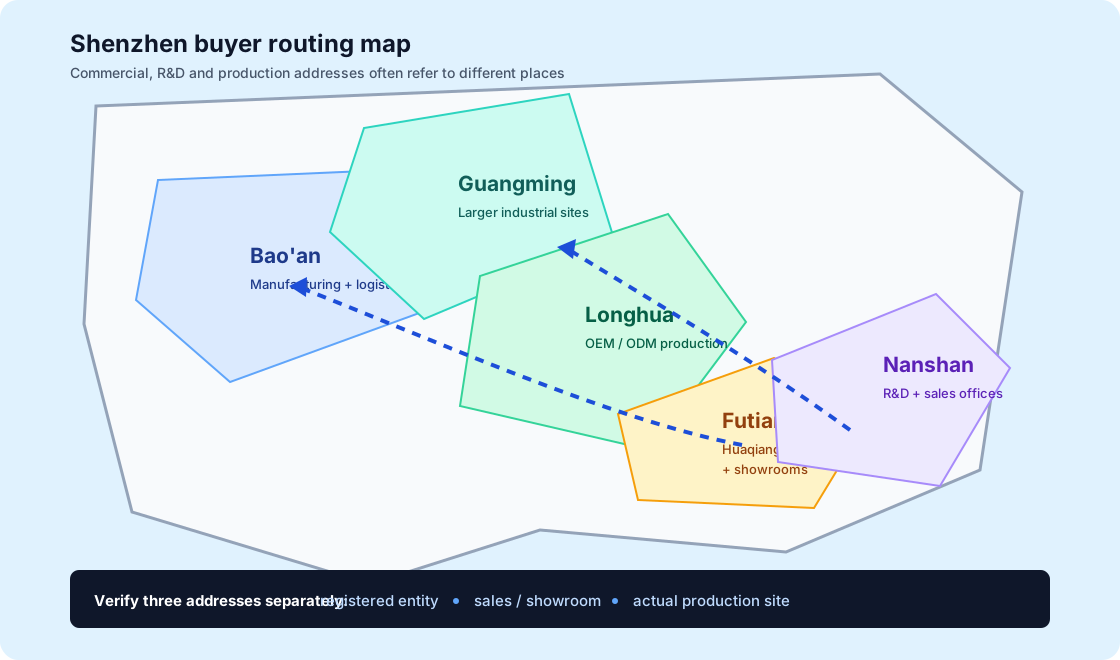
Huaqiangbei (Futian District)
Huaqiangbei is the commercial heart of Shenzhen's electronics trade. It's not one market but a district of interconnected electronics malls, each with its own character:
- SEG Plaza (赛格广场) — The tallest and most iconic. Lower floors are component markets (ICs, connectors, passives); upper floors have finished products (accessories, gadgets, consumer electronics). Expect to navigate narrow aisles and negotiate.
- Huaqiang Electronics World (华强电子世界) — Larger stalls, more finished products, slightly less chaotic than SEG. Good for finding suppliers with more established operations.
- Shenzhen Electronic Component Market — Focused on components and modules rather than finished goods. Engineers and prototypers gravitate here.
Huaqiangbei is not where your production orders get manufactured. It's where you research the market, find component sources, meet potential suppliers, and understand what's available. The actual factories are elsewhere.
Longhua District
Longhua is a major manufacturing zone north of the city center. It's dense with mid-size to large electronics factories, particularly for consumer electronics assembly, PCB assembly, and IoT products. Foxconn's Shenzhen campus is in Longhua, and the surrounding supply chain serves it and other large manufacturers.
Many Huaqiangbei trading companies' underlying factories are in Longhua. When a supplier has a showroom in SEG Plaza and says "our factory is nearby," Longhua is likely where it is.
Bao'an District
West of the city center, Bao'an has extensive industrial zones with a mix of electronics, plastics, and tooling. It's adjacent to Shenzhen Bao'an International Airport and major logistics hubs, making it convenient for export-oriented manufacturing. Bao'an factories tend to be more established than Longhua's newer operations.
Guangming District
Further northwest, Guangming is Shenzhen's newer industrial expansion zone. It houses larger factories requiring more floor space, including precision machining, advanced display manufacturing, and medical device production. Land is more available here, and factories tend to be newer builds with modern layouts.
Nanshan District
Nanshan is Shenzhen's tech headquarters zone — Tencent, ZTE, and thousands of tech companies have offices here. It's not a manufacturing district but the R&D and corporate center. Many OEM/ODM factories have their sales offices in Nanshan while production runs in Longhua, Bao'an, or Guangming. A supplier whose address is in Nanshan may be a sales office for a factory elsewhere, or a trading company, or a design house — rarely the factory itself.
District Comparison
| District | Primary Function | Supplier Types | Notes |
|---|---|---|---|
| Futian (Huaqiangbei) | Commercial / Trading | Trading companies, component sellers, showrooms | Not where production happens; useful for research and prototyping |
| Longhua | Manufacturing | Mid-to-large OEM/ODM factories, PCB assembly | Foxconn supply chain; strong in consumer electronics |
| Bao'an | Manufacturing / Logistics | Established factories, export-oriented | Near airport and logistics hubs |
| Guangming | Manufacturing | Large factories, advanced manufacturing | Newer industrial zone; more floor space |
| Nanshan | R&D / Corporate | Sales offices, design houses, tech HQs | Rarely the production site; verify factory location separately |
Supplier Verification in Shenzhen
The Address Problem
The single most common verification issue in Shenzhen: the supplier's registered address, showroom address, and factory address are three different locations, and the supplier only wants to show you the showroom. A polished showroom in SEG Plaza with samples on display is not evidence of manufacturing capability. The factory — likely in Longhua, Bao'an, or Guangming — is what needs to be verified.
Ask every supplier: "What is the factory address? Can I visit the production floor?" If the answer is "our showroom is at [Huaqiangbei address]," repeat the question about the factory specifically.
Factory Visit Checklist
- Confirm the factory address separately from the sales office address
- Visit during working hours — a quiet factory floor is a red flag
- Observe SMT lines, assembly stations, testing areas
- Check for company signage matching the business license
- Look at work-in-progress — what products are being made right now?
- Inspect the QC area — what testing equipment is present?
- Check component storage — organized, labeled, ESD-safe?
- Observe worker count, uniforms, safety equipment
- Ask to see production records and QC reports for recent orders
- Note equipment brands (Panasonic, Fuji, Yamaha for SMT; Agilent, Keysight for test equipment suggest serious investment)
Common Shenzhen-Specific Red Flags
| Red Flag | Significance |
|---|---|
| Supplier only wants to meet at Huaqiangbei showroom, won't disclose factory address | Likely a trading company with no owned factory |
| Multiple suppliers claim the same factory as theirs | The factory sells through multiple trading channels; you're not dealing with the factory directly |
| Factory address is in a commercial building, not an industrial zone | Not a factory; office-based operation |
| SMT line is idle during working hours | Low production activity; question capacity claims |
| Factory has no ESD protection (no grounded workstations, no wrist straps) | Inadequate electronics manufacturing practices |
| Component storage is disorganized or unlabeled | Traceability problems; quality risk |
| Supplier's website lists 50+ unrelated product categories | Trading company, not a focused manufacturer |
Quality and Certification Risks
Component Authenticity
Counterfeit and remarked components are a persistent issue in Shenzhen's electronics supply chain. A component that looks correct — right markings, right package — may be a used part cleaned and remarked, a lower-spec part relabeled, or a completely different component in the right package.
For production orders, specify component sourcing requirements:
- Authorized distributor only for critical components
- Traceability to manufacturer lot/batch
- Component authenticity testing for high-risk parts (X-ray inspection, decapsulation, electrical testing)
- Source control documentation
This adds cost and lead time but prevents the much larger cost of product failures in the field.
Certification Documentation
Shenzhen electronics factories vary enormously in their certification sophistication. Some maintain current, comprehensive certifications (ISO 9001, ISO 14001, BSCI, product-specific certifications like CE, FCC, UL, RoHS, REACH); others have expired certificates, certificates registered to different entities, or no certifications at all.
For each certification a supplier claims:
- Note the certificate number
- Verify through the issuing body's database
- Confirm the certificate covers the specific factory address and production scope
- Check validity dates
For product-level certifications (CE, FCC, UL), confirm whether the certification covers your specific product model or a reference design. A CE certificate for "Bluetooth speaker model X-100" doesn't cover your company's "Bluetooth speaker model Y-200" even if they're physically identical — the certification is tied to the applicant and model number.
EMC and Wireless Compliance
Products with wireless functionality (Bluetooth, WiFi, cellular) and products with switching power supplies need EMC testing and certification for most destination markets. Shenzhen has numerous EMC test labs that can perform pre-compliance testing before formal certification. The cost is modest (typically $500-$2,000 for pre-compliance testing) and can identify issues before expensive formal testing.
Certification and Compliance Risk Overview
| Risk Area | Common Issues | Mitigation |
|---|---|---|
| Component authenticity | Counterfeit or remarked ICs; used parts cleaned and relabeled; lower-spec parts in correct packaging | Specify authorized distributor sourcing; require traceability to manufacturer lot; X-ray/decapsulation testing for critical parts |
| Certification validity | Expired certificates; certificates registered to different entities; cert scope does not match product | Verify every certificate number through issuing body database; confirm scope covers the factory and product |
| Product certification applicability | CE/FCC/UL cert for reference design does not cover your model; cert tied to different applicant | Confirm certification covers your specific model number and applicant; plan for re-certification if needed |
| EMC pre-compliance gaps | Products fail formal testing because pre-compliance was skipped or inadequate | Budget for pre-compliance testing early in development; $500–$2,000 is modest vs cost of redesign after formal test failure |
| Documentation gaps | Supplier provides certificates but cannot produce test reports or technical files | Request the full technical documentation package; a certificate without supporting test data is incomplete |
Sourcing Routes
Route 1: Market Research → Factory Identification
- Visit Huaqiangbei to understand product categories, pricing, and trends
- Identify products similar to what you want to source
- Ask sellers who manufactures the product — some will tell you, many won't
- Use the product's characteristics (PCBA design, component choices, enclosure style) to identify the likely manufacturing cluster
- Search for factories directly through industry directories, trade shows, and B2B platforms with specific product specifications
- Verify the factory independently before engaging
Route 2: Trade Shows
Shenzhen hosts multiple electronics trade shows annually. The major ones:
- China Electronics Fair (CEF) — Broad electronics and components
- Shenzhen International Electronics Exhibition — Manufacturing equipment and solutions
- Consumer Electronics Show (CES) Asia — When held in Asia, often in Shanghai, but Shenzhen suppliers attend
Trade shows let you meet multiple suppliers in person, see product quality directly, and gather catalogs and capability information efficiently.
Route 3: Online Platform Sourcing
Alibaba, Made-in-China, and Global Sources list thousands of Shenzhen electronics suppliers. The key to effective platform sourcing:
- Filter by "Manufacturer" (but verify independently — the platform's classification is self-reported)
- Look for suppliers with 5+ years on the platform, verified status, and transaction history
- Check the supplier's other products — a focused catalog suggests specialization; an unfocused one suggests trading
- Message with specific technical questions and evaluate response quality
Route 4: Sourcing Agent
A Shenzhen-based sourcing agent provides local presence for supplier identification, verification, negotiation, quality inspection, and logistics coordination. This is particularly valuable when:
- You're developing a complex product with custom electronics
- You don't have in-house Mandarin capability
- The order value justifies the agent's fee (typically 5-10% of order value)
- You need ongoing inline inspection during production
- You're sourcing across multiple Shenzhen factories for different components
When to Use a Sourcing Agent in Shenzhen
A sourcing agent adds the most value in Shenzhen when:
- Product complexity is high — Custom PCB design, firmware development, multi-component assembly benefit from local engineering oversight
- Quality requirements are stringent — Medical devices, safety-critical products, products sold through major retailers need inspection rigor
- You're new to electronics sourcing — The learning curve is steep; an agent accelerates it
- You need ongoing production monitoring — Not just pre-shipment inspection, but inline QC during production
- Language and cultural barriers are significant — Technical discussions about PCB design, component specifications, and testing protocols require precise communication
For simple off-the-shelf products at low volumes, a sourcing agent's fee may not justify the value. For custom electronics at production volumes, it usually does.
Huaqiangbei vs Factory Sourcing: Which Route When
| Sourcing Route | Best For | Not Ideal For | Key Consideration |
|---|---|---|---|
| Huaqiangbei market first | Market research, trend spotting, prototyping components, initial supplier meetings | Production orders, quality-critical components, traceability requirements | Use to identify products and suppliers, then trace back to the factory |
| Direct factory sourcing | Production volumes, custom designs, quality-controlled manufacturing | Quick-turn market testing, multi-category sourcing, very small orders | Verify factory independently; a showroom in Huaqiangbei is not a factory |
| Trade shows | Meeting multiple suppliers efficiently, seeing products firsthand, gathering capability data | Immediate production; shows happen on fixed schedules | Collect catalogs and capability info; follow up with factory visits |
| Online platforms (Alibaba, Global Sources) | Broad supplier discovery, initial filtering, transaction history review | Final verification; platform classifications are self-reported | Verify "Manufacturer" classification independently |
| Sourcing agent | Complex custom electronics, stringent quality requirements, lack of in-house Mandarin capability | Simple off-the-shelf products at very low volumes | Agent fee (commonly 5-10% of order value) should be weighed against order complexity and value |
Next Steps in Regional Sourcing
Understanding a region's ecosystem is the first step — turning that knowledge into supplier relationships is the next. For buyers who want support:
- Regional supplier shortlist: We can identify verified manufacturers in the production regions that match your product.
- Supplier verification: Business license checks, certification validation, and factory capability assessment for electronics suppliers.
- Factory audit and inspection coordination: On-the-ground quality verification through accredited third-party providers.
FAQ
Is Huaqiangbei the right place to find a factory for production orders?
No. Huaqiangbei is a trading and component market, not a manufacturing district. It's excellent for market research, prototyping components, and initial supplier meetings, but the actual factories are in Longhua, Bao'an, and Guangming districts. Use Huaqiangbei to identify products and suppliers, then trace them back to the factory for production discussions.
How do I tell if a Shenzhen electronics supplier is a real factory?
Request a visit to the production floor, not the showroom. The factory should be in an industrial zone (Longhua, Bao'an, Guangming), have SMT lines and assembly stations, show work-in-progress inventory, and match the business license details. A supplier whose only address is in Huaqiangbei or Nanshan is almost certainly not a factory.
What's the minimum order quantity for custom electronics from Shenzhen?
For PCB assembly, prototype quantities of 5-50 boards are standard, though per-unit costs are high. For consumer electronics with custom tooling (enclosure molds), MOQs typically start at 500-1,000 units for the enclosure and 1,000+ for the assembled product. Off-the-shelf products (OEM products with your branding) can start at 100-500 units. The major cost inflection points are at 1,000 and 5,000 units.
How do I protect my IP when sourcing electronics from Shenzhen?
Register patents, trademarks, and design rights in China before disclosing to suppliers. Use NNN agreements (non-disclosure, non-use, non-circumvention) drafted for Chinese legal context — not generic Western NDAs. Split manufacturing across multiple suppliers (PCB assembly at one, final assembly at another) so no single factory has the complete design. Mark firmware with identifiers that can trace unauthorized copies. Consult qualified IP counsel with China experience for strategy.
What are the biggest quality risks with Shenzhen electronics?
Component authenticity (counterfeit or remarked ICs), PCB quality (thin copper, poor plating), soldering defects (cold joints, bridging), firmware bugs in rushed development, inconsistent assembly quality between samples and production, and EMC/regulatory non-compliance. Most of these can be detected with specified testing protocols and third-party inspection — they're not inherent to Shenzhen manufacturing but to the level of quality investment at a given factory.
How fast can Shenzhen factories turn around a prototype?
For a simple PCB (2-4 layers, standard process), fabrication can be completed in 24-48 hours, and assembly in another 24-48 hours. For a consumer electronics prototype with custom enclosure (3D-printed or CNC-machined), plan for 1-2 weeks. For a production-ready sample with production tooling, plan for 4-8 weeks including mold fabrication, PCBA, and assembly. These timelines assume standard specifications — unusual materials, complex designs, or certification requirements add time.
Should I source from Shenzhen or other Chinese cities for electronics?
Shenzhen for speed, innovation, complexity, and integration. Dongguan for slightly lower costs with good electronics capability (Dongguan's Songshan Lake area has significant electronics manufacturing). Shanghai/Suzhou for higher-end industrial electronics and closer proximity to Japanese/Korean component supply chains. Inland provinces (Hubei, Sichuan, Henan) for lowest-cost commodity electronics production. Start in Shenzhen; move elsewhere if cost reduction at scale becomes the priority.
How do I handle certification (CE, FCC, UL) for Shenzhen-made electronics?
Work with a test lab early — pre-compliance testing during development identifies problems before formal certification. For CE marking (EU), use a notified body if the product category requires it. For FCC (US), use an accredited test lab. For UL (US safety), factor in 6-12 weeks for testing and certification. Budget $2,000-$10,000+ for certification depending on product complexity and wireless functionality. Shenzhen has numerous test labs that can handle the full certification process.
What's a realistic budget for developing a consumer electronics product in Shenzhen?
A simple Bluetooth accessory with existing reference design: $5,000-$15,000 for tooling, prototyping, and initial production setup. A custom IoT device with new PCB design, firmware, enclosure tooling, and certification: $30,000-$100,000+. A complex product with custom industrial design, multiple PCBs, firmware, mobile app, and full regulatory certification: $100,000-$500,000+. These are development and setup costs, not per-unit production costs.
How do I find reliable PCB assembly partners in Shenzhen?
Start with industry directories (PCB Directory, SMT Net) and trade show exhibitor lists. Request capability statements: minimum trace/space, minimum via size, layer count capability, surface finishes offered, inspection equipment (AOI, X-ray), and quality certifications (IPC, ISO). Visit the facility. Start with a small order to evaluate quality, communication, and reliability before committing to production volumes. A good PCB assembly partner should be transparent about capabilities, responsive to technical questions, and willing to provide references.
This guide reflects general sourcing practice and is not legal, regulatory, or compliance advice. Shenzhen's electronics ecosystem, market conditions, and regulatory requirements change frequently. Buyers should independently verify all supplier claims, certification status, and compliance documentation. Manufacturing costs, lead times, and MOQs are estimates — actual figures depend on product specifications, order volumes, and market conditions. All supplier representations should be treated as claims requiring verification. IP protection strategy should be developed with qualified legal counsel experienced in Chinese IP law.